Alex Woo designed the dream worlds of In Your Dreams around a tension that makes dreams unsettling: they can feel real while they are happening. The film moves between recognisable family life and highly stylised fantasy without treating the two as cleanly separate places. Woo told Netflix Tudum that the team wanted viewers to be unsure, at times, whether a scene belonged to a dream or reality.
That uncertainty gives the visual invention a job beyond spectacle. Stevie and Elliot enter shared dreams while trying to hold their family together after learning that their parents may separate. Their journey toward the Sandman has odd encounters, changing environments and exaggerated imagery. Yet Woo rooted the story in the siblings’ fear, hope and attachment to each other.
A dream can look convincing
Woo’s starting point was the familiar strangeness of dreaming. He described dreams as experiences that often feel real, even when the dreamer does not recognise them as dreams. His design goal was to use that feeling on screen, then place it beside sections of the dream world with a deliberately heightened style.
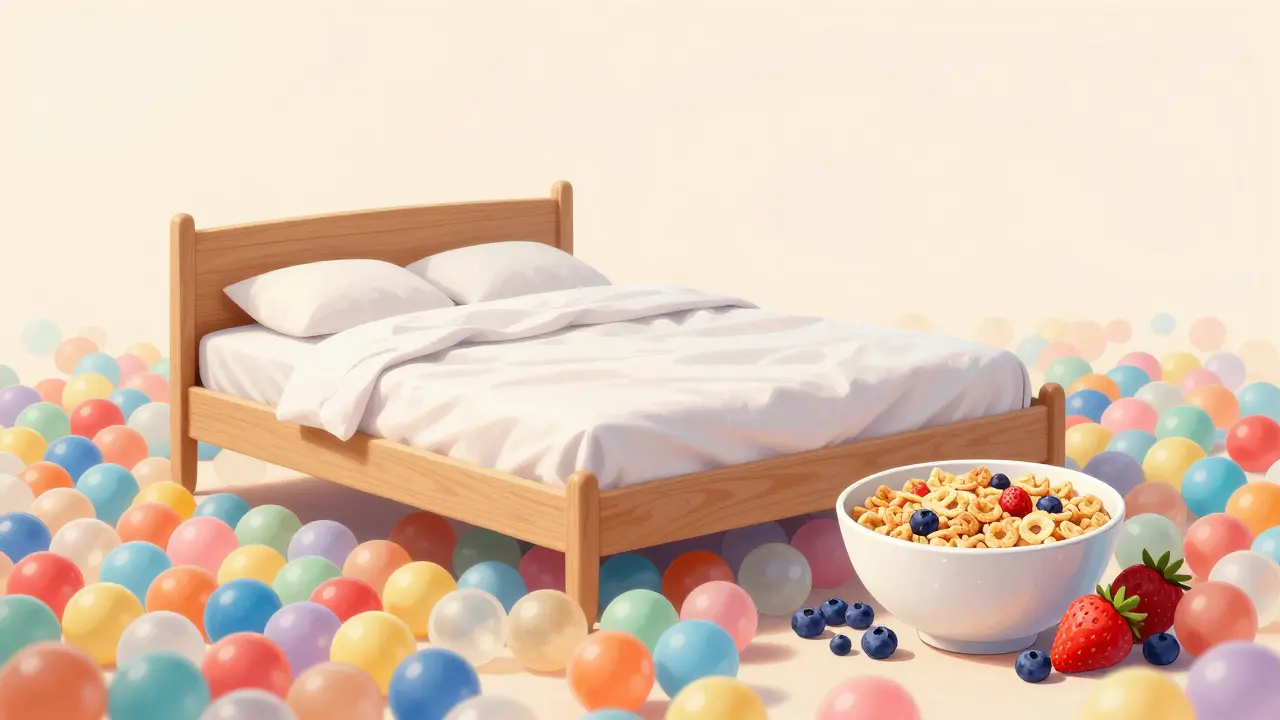
The shifts are part of the film’s storytelling. A room, a family moment or a shared adventure can carry enough emotional truth to feel grounded. Then the film can swing into imagery that follows dream logic: a giant cereal bowl, a colossal teddy bear or a river of plastic balls. The contrast lets the audience feel the border between reality and fantasy move rather than sit in one fixed place.
Woo wanted the dream sequences to change visually as the dreams twist and unfold. Sebastian Kapijimpanga, the film’s head of character animation, said the early pitch included 2D art and a broad range of environments. He described the assignment as feeling like “10 movies in one” because the dream setting allowed so many kinds of places and visual approaches.
That freedom still needed limits. A dream world can contain almost anything, but the audience needs to understand what matters to Stevie and Elliot. The film returns to the siblings’ shared purpose: they want the Sandman to grant a wish that will keep their family together. The strange places matter because the children carry that wish through them.
The breakfast world has its own rules
One of the clearest examples of the film’s visual design is its breakfast sequence. Production designer Steve Pilcher said the food itself became alive. Strawberries and blueberries are characters, rather than ingredients used to construct buildings.
Pilcher drew a line between that approach and a more familiar food-world design. The buildings were made from craft materials such as popsicle sticks and milk cartons. He connected those materials to Stevie’s playtime. The food characters and handmade environment gave the sequence a specific visual identity.
The choice also set rules for the world. Pilcher said he believes each fantasy setting needs its own rules so it feels consistent and fun. In this case, living food shares the screen with a craft-built setting. The result is a breakfast setting that can be strange without becoming visually random.
| Design element | What the filmmakers described |
|---|---|
| Food characters | Strawberries and blueberries are characters in the sequence. |
| Built environment | Popsicle sticks and milk cartons form the craft-world setting. |
| Story link | The materials reflect Stevie’s playtime. |
| World rule | The sequence follows its own imaginative rules for consistency. |
This is why the breakfast world reads as more than a loose collection of comic images. It has an internal visual logic. Pilcher’s account makes the distinction plain: the film does not simply cover every surface with food. It creates characters from food, then gives them a setting built from objects associated with a child’s play.
Influences that point in different directions
Woo named several influences for In Your Dreams, and they do not all pull toward the same kind of fantasy. He cited Matthew Walker’s book Why We Sleep: Unlocking the Power of Sleep and Dreams. He also cited Hayao Miyazaki’s Spirited Away, Christopher Nolan’s Inception, and 1980s adventure films including The Goonies and E.T. the Extra-Terrestrial.
Those references describe the territory Woo was exploring, not a checklist of scenes copied into the film. Spirited Away offered a mystical animated world. Inception gave him a live-action exploration of dreaming. The 1980s adventure films provided another point of reference for children moving through a larger-than-life quest.
Woo had worked on Ratatouille and WALL-E during his time at Pixar. He called an animated feature about dreams a long-standing ambition in animation, while identifying a difficult story problem: a dream needs real stakes if what happens inside it is to matter.
The film answers that problem through Stevie and Elliot’s family situation. Their dreams do not need to produce a literal solution to every fear for the story to have weight. What matters is what the siblings bring into the dream world, and what their search reveals about their desire to restore stability at home.
Fantasy carries a family story
In Your Dreams is Woo’s feature directorial debut and the first feature from Kuku Studios, which he cofounded. The film follows Stevie and Elliot after they suspect their parents are separating. Their differences shape the story: Stevie seeks order, while Elliot has a more chaotic approach to life.
Woo connected the emotional core to his own childhood. He recalled waking at age six in Minnesota to find his mother at the front door with bags packed, telling him and his brother that she needed time away to work out what was happening in their family. He said that morning showed him that life was far from perfect.
He also described the schemes he and his brother made to save their family. He said those attempts did not work, but that the bond the brothers built helped them move through uncertainty. That personal source helps explain why the film focuses on the relationship between Stevie and Elliot rather than only on its dream imagery.
Woo said he consulted two child psychologists while developing the portrayal of children facing family fracture. He showed them early versions of the film. Their concern, he said, was that an animated family film might smooth over difficult emotions or conversations. Woo said the filmmakers wanted the characters to be treated as though the events were really happening to them.
That choice affects the dream design. The fantasy is colourful and absurd, but it does not erase the family’s problems. Woo described the film as able to be “completely absurd and hilarious” while also grounded and emotional. The film’s changing styles, odd creatures and exaggerated settings work alongside a story about two children trying to understand a situation they cannot control.
The director also framed the film as wary of a simple message about pursuing dreams at any cost. He said that dreams coming true may carry a cost, and that Stevie eventually prefers messy reality to a fantasy realm. His stated ending point is optimism rooted in real relationships and in people working together.
That gives the dream worlds their purpose. They are places where Stevie and Elliot can test wishes, fears and plans that are difficult to face at home. The breakfast world’s living fruit and craft-built scenery, the shifting visual styles and the uncertain boundary between sleep and waking all serve the same family story. Woo’s design does not ask viewers to forget reality. It asks them to see why reality, with all its disorder, still matters.
For a separate animated-film people story, read Fotobreak’s piece on Mira’s speaking and singing voices in KPop Demon Hunters.
