Spoilers for Glass Onion: A Knives Out Mystery follow. Janelle Monáe plays both Cassandra “Andi” Brand and her twin sister, Helen Brand. The first half presents the woman on Miles Bron’s island as Andi. The midpoint reveals that Andi has already died and that Helen has taken her place to investigate alongside Benoit Blanc.
That reveal changes how the audience reads Monáe’s performance. It also changes the clothes, accessories, and hair. Costume designer Jenny Eagan built a polished visual language for the Andi Helen is trying to imitate, while Helen’s own clothes point to a different life. Rian Johnson later identified one tiny hair detail that separates the sisters: Helen gets the overall reference close, yet wears her part on the opposite side.
The clothes are clues, though they do not solve the mystery by themselves. They show the strain of Helen’s disguise and give the film a visual pattern to revisit once its second half begins.
Andi is dead before the island trip
The woman who arrives late at Miles Bron’s Greek island getaway appears to be Andi, the former business partner whose relationship with Bron and his circle has collapsed. The film later returns to events before the trip. Helen has contacted Blanc after Andi’s death, which has been presented as a suicide. Helen doubts that explanation and agrees to impersonate her sister while Blanc investigates.
That setup matters because the island wardrobe belongs to two characters at once. Helen wears it on screen, but she has chosen it as her version of Andi. The distinction avoids a common reading of the film: the sleek white suit, dramatic dresses, and bold accessories do not simply document Andi’s ordinary island style. They form the look Helen believes her sister would choose.
Eagan described this idea directly in Netflix Tudum’s account of the costumes. She said Helen would have gone through Andi’s closet and selected pieces she thought her sister would wear. Helen admires Andi, Eagan explained, while also bringing her own strength to the impersonation.
The disguise therefore carries an emotional purpose beyond plot mechanics. Helen does not enter the island as a neutral detective. She steps into the public image of a sister she has lost, then must hold that image together in front of people who knew Andi as a business partner, friend, rival, or obstacle.
Jenny Eagan gives Andi a sharp silhouette
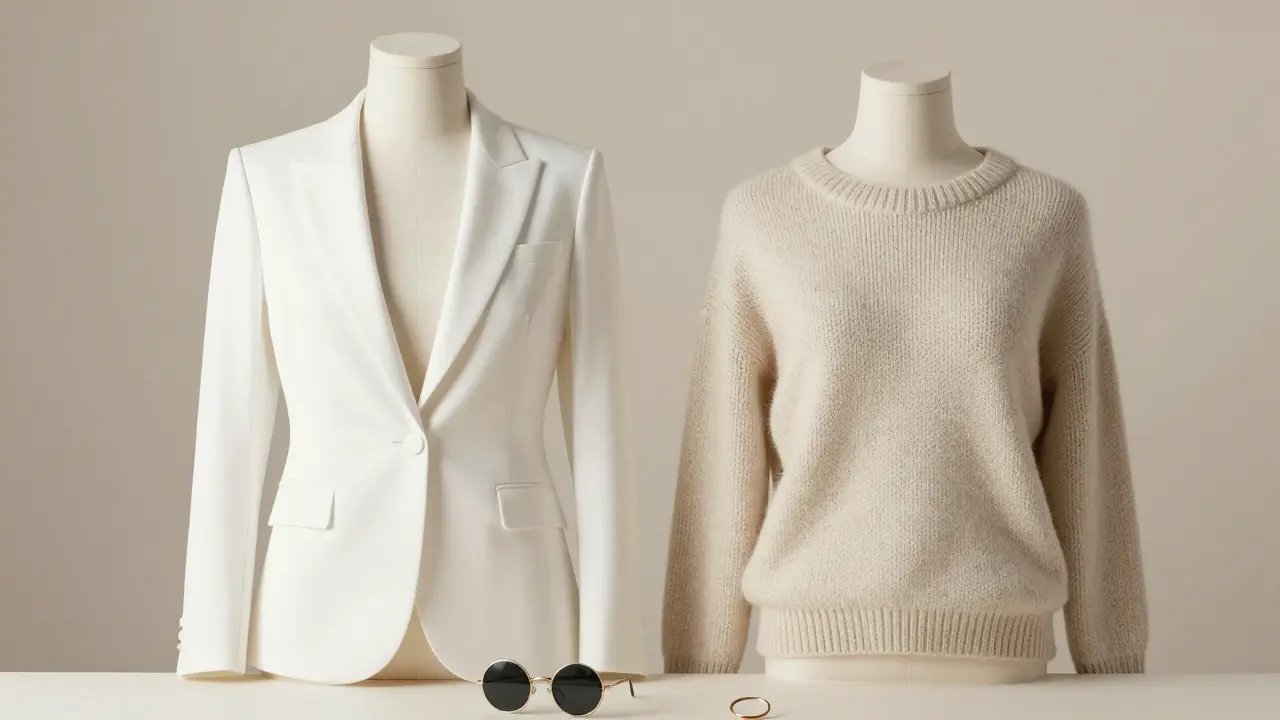
Eagan wanted viewers to understand Andi quickly as an intelligent and powerful woman. She described the design in terms of sharp lines and simple cuts. The white cocktail-hour suit is one clear expression of that choice. It has a controlled, corporate polish suited to the version of Andi the island guests expect to see.
The design also helps the opening half play fairly. Helen has to pass as a woman whose social position and taste look different from her own. An audience watching for the first time may register the confident tailoring before they know whose confidence they are actually seeing.
Monáe worked with Eagan on both characters’ looks. Eagan said their collaboration covered Andi’s sleek corporate image and Helen’s more relaxed Alabama teacher sweaters. Monáe also told Netflix that Andi needed to have taste, an intention reflected in the careful styling of the disguise.
For another film where one actor’s separate roles shape the way viewers read a story, see Mia Goth’s two roles in X, Pearl, and MaXXXine. Glass Onion uses the double role differently. Helen is not playing a new identity for the audience alone. She is performing for suspects who may have reasons to fear what Andi knows.
The circles belong to the constructed Andi look
Eagan also pointed to recurring geometric shapes, especially circles, in the clothing and accessories associated with the woman the guests believe is Andi. The film includes a circular purse, circular rings, oversized round sunglasses, a belt with a circular detail, and a red swirl pattern near the bottom of a dress. Eagan described circles as appearing in almost everything the character has.
The repetition supports the film’s eventual return to its earlier events. Once viewers know Helen is wearing a constructed version of Andi, those round forms gain a second purpose. They fit the film’s repeated action: the story comes back to moments the audience has already watched, then changes their meaning through Helen’s point of view.
The costume source connects the circles to the twist and to the idea of events coming full circle. That does not mean every round object in the film has one fixed explanation. Eagan identified a pattern in the wardrobe, not a rule that assigns a secret plot function to every circle on screen.
| Detail | What the film’s official material supports |
|---|---|
| Sharp lines and simple cuts | Eagan used them to establish Andi as smart and powerful. |
| White cocktail-hour suit | It belongs to the polished visual image Helen constructs for Andi. |
| Circular purse, rings, belt, sunglasses, and dress swirl | Eagan identified circles as a recurring feature of the Andi look. |
| Relaxed sweaters | Eagan contrasted them with Helen’s own Alabama teacher wardrobe. |
| Hair part | Johnson said Helen’s part sits on the opposite side from Andi’s. |
Helen’s own clothes create the contrast
Helen’s regular wardrobe gives the impersonation its tension. Eagan contrasted the sleek corporate image with Helen’s laid-back Alabama teacher sweaters. That contrast does not make Helen less capable. She hires Blanc, takes the risk of going to the island, and continues the investigation after the first apparent attempt on her life.
The difference is social as much as visual. Andi’s constructed look matches the image of a former tech-company co-founder who arrives at an exclusive island gathering in tailored clothes and attention-grabbing accessories. Helen’s sweaters belong to a woman introduced outside that wealthy setting. When she copies Andi’s look, the film asks her to cross a class boundary while keeping her real reactions hidden.
This is why the costumes work best when treated as character information rather than a scavenger hunt. Helen’s clothing changes because her situation changes. She needs the other guests to accept a familiar image long enough for Blanc to learn what happened to Andi.
The hair part is the cleanest visual tell
Johnson gave viewers one specific way to distinguish the sisters. In his director’s commentary, he said Helen had a hair reference and recreated it through a mirror. She gets close, but her part is on the other side.
It is a wonderfully small error because it matches the story. Helen knows her sister well enough to build a credible look. She is also under pressure, working from an image rather than living as Andi every day. The reversed part marks the gap between resemblance and identity.
The clue has limits. It is useful on a rewatch, after the film has disclosed the twin switch. It is not presented as a clue that the island guests openly notice and solve. Johnson’s comment gives the audience a precise detail to inspect, while the plot’s major revelation arrives through Blanc’s explanation and the flashback structure.
That restraint suits a mystery built on information management. Glass Onion gives viewers visual material in plain sight, then asks them to reconsider it only after the narrative has supplied the missing context.
Why the second perspective changes the first half
Johnson described the film’s shape as a fugue-like structure. The movie splits around a central revelation, then repeats the first half from a different perspective. The earlier scenes do not play exactly the same way because Helen’s knowledge, anxiety, and goals now sit in the foreground.
The shift also gives the audience a new character to follow. The first act largely centers on Blanc and the eccentric guests around Bron. The flashback reveals Helen’s reason for entering their world and turns her from an apparently enigmatic arrival into the person carrying the investigation’s emotional weight.
That change reaches the costumes and hair. A white suit can first read as Andi’s controlled entrance. After the reveal, it reads as Helen’s attempt to inhabit a sister’s public image. A recurring circle can first look like a styling motif. Later, it fits a story that has looped back to show what the audience missed. A hair part can look ordinary until Johnson points out that it is slightly wrong.
The film does not ask viewers to treat clothes as evidence equal to the murder investigation. It uses them to make the double role legible on another viewing. Eagan’s designs give Andi a coherent silhouette. Helen’s own wardrobe supplies the contrast. Johnson’s hair detail gives the disguise one quiet imperfection.
On a rewatch, which moment makes Helen’s performance feel most different after the reveal? Does the reversed hair part change how you read the island scenes, or do the clothes reveal more about the disguise?
