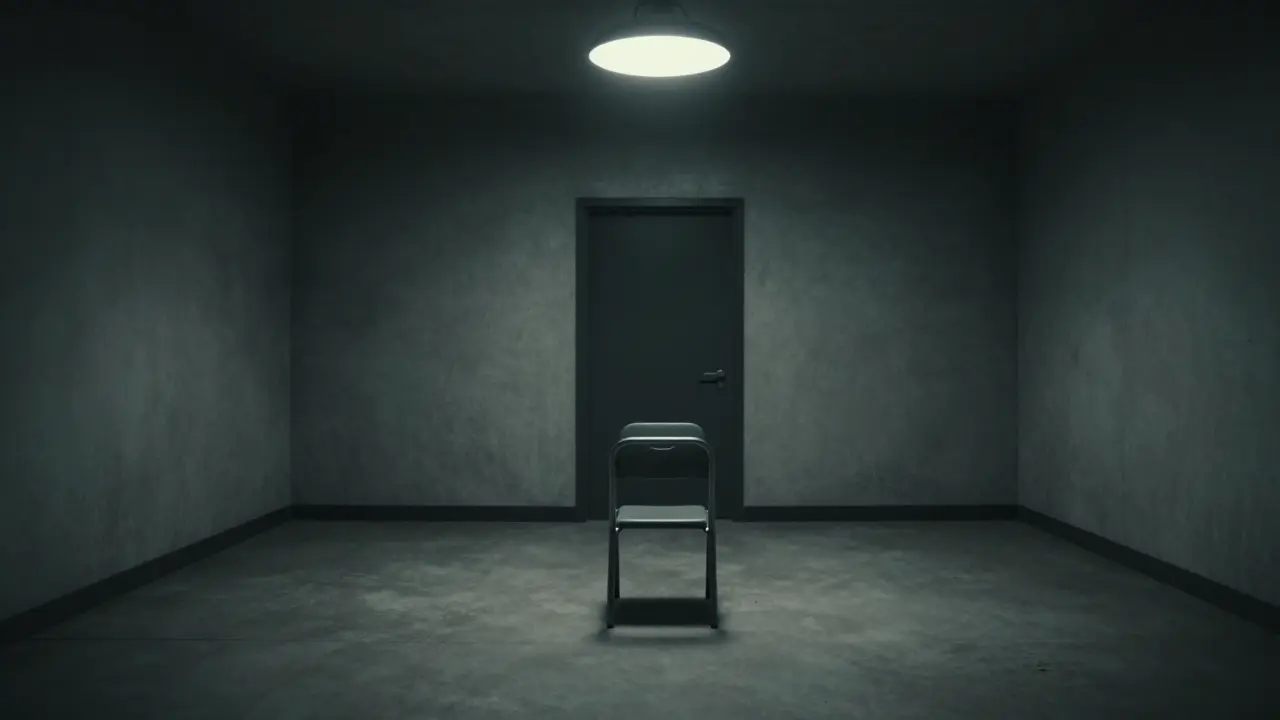
Lee Harker’s unease in Longlegs came from preparation, close work with director Osgood Perkins, and the film’s controlled visual language. Maika Monroe described rereading the screenplay after learning what it reveals about Lee near the end. She then worked through the investigation’s details with Perkins, while long shots gave the character room to sit inside her discomfort.
Lee is an FBI agent assigned to a case involving family murders, coded messages, and the figure known as Longlegs. The film presents her as isolated and carrying suppressed trauma. She also has an ability that her supervisor describes as “half-psychic.” Those traits shape how she moves through the investigation: watchful, withdrawn, and never fully at ease.
For viewers interested in another actor carrying a horror story through a deliberately stylized performance, see Mia Goth’s two roles in X and Pearl.
Rereading the script with Lee’s ending in mind
Monroe said her first read changed direction after roughly 30 or 40 pages. The screenplay’s turns caught her off guard, and she became absorbed by it. Once she knew where Lee’s story led, she read it again to understand the character’s emotional position at each earlier point.
That rereading mattered because Lee’s history is partly concealed. Monroe described the character as someone who had endured a great deal of trauma and kept much of it suppressed. A performer can play that kind of character too openly and give away the tension. Monroe’s account suggests a more contained approach: the information exists inside Lee, while her behavior reveals it only in fragments.
Perkins has cited Clarice Starling from The Silence of the Lambs as an influence on the film. Monroe acknowledged that influence, yet she separated Lee from Clarice. She wanted room to build her own character rather than treat the earlier role as a template. The comparison makes sense at the level of premise, since both characters investigate violent crimes, but Monroe’s Lee has a different emotional rhythm. She often seems stranded inside a room, even when other people are present.
Building the investigation from the inside
Monroe was drawn to the FBI side of the role. She said that crime movies had interested her since childhood, and one of the production’s first filming days involved a crime scene. Her enthusiasm was not limited to the broad idea of playing an agent. She focused on how the case connected.
She recalled being strict about codes, case details, and the logic needed to piece the investigation together. Monroe said she and Perkins spent many hours adapting dialogue and other material so those details made sense to her. She also said the notebooks seen in the film had been thought through.
This does not establish that Longlegs depicts real FBI procedure with documentary accuracy. Monroe’s comments describe how she pursued internal consistency for Lee and for the fictional case. That distinction matters. The performance gains conviction when Harker studies evidence or follows a lead because Monroe had worked to understand what those details meant within the story.
| Performance element | What Monroe described | Effect within the film |
|---|---|---|
| Second reading of the script | Revisiting the screenplay after learning Lee’s later revelations | Helps track what Lee may be repressing earlier |
| Case material | Checking codes, notes, dialogue, and the case’s internal logic | Gives Harker’s investigative work a grounded focus |
| Collaboration with Perkins | Bringing role-specific ideas to a director open to discussion | Connects character choices to the film’s precise design |
| Long takes | Discussing the visual plan with Perkins and cinematographer Andrés Arochi Tinajero | Leaves Harker exposed inside quiet, uncomfortable spaces |
A director with a fixed image and room for ideas
Monroe described Perkins as having a strong vision while remaining open to collaboration. She had ideas that mattered to her performance, and she said he supported them. That balance fits the finished film’s feel. The frame often appears rigorously controlled, yet Lee’s reactions retain a raw and uncertain quality.
Monroe also spoke about conversations with Perkins and cinematographer Andrés Arochi Tinajero. The visual approach was highly specific, and she enjoyed that precision. Their discussions included the long shots in which she appears alone. Monroe said those shots gave her room to remain in uneasy places.
The critic Michael Gingold saw a similar effect in the completed film. In his review, he described Perkins and Tinajero holding scenes in long static shots, with occasional lateral movement or slow zooms. For Gingold, that stillness creates expectation: the viewer waits for something to intrude. When the camera begins to follow Harker, he wrote, the movement itself can signal approaching danger.
That observation belongs to Gingold’s critical reading, not to Monroe’s account of production. Put together, the interview and review show two sides of the same result. Monroe discussed acting within a strict visual plan; Gingold assessed how that plan makes the audience uneasy.
Long takes leave nowhere to hide
A long take can ask a different kind of concentration from an actor. The camera continues to look. Small changes in posture, pace, and attention stay visible. Monroe’s scenes alone on screen had to sustain tension without relying on quick cutting.
The review describes the film as using extended static compositions, slow camera moves, sudden edits, brief flashes, and changes in aspect ratio. Gingold judged these choices purposeful rather than decorative. He also credited the sound design by Eugenio Battaglia and the score by Zilgi with shifting a crisp rural setting toward a more disturbing mood.
Monroe later said the cinematography surprised her when she watched the finished film. She knew the intended aesthetic of some shots during production, yet she felt Tinajero’s work elevated the movie and created unease even in simple scenes. That reaction points to an important limit of an actor’s set experience: performers may know framing plans without seeing how every image, sound, edit, and performance will combine.
Meeting Nicolas Cage only when the cameras rolled
The first encounter between Lee and Longlegs had a production choice built into it. Monroe said Perkins did not want her to meet Nicolas Cage or see photographs of his makeup before that scene. Her first sight of him in character came when “Action” was called and she walked onto the set.
Monroe described the first take as a raw, visceral reaction. She then tried to retain that feeling through later takes and coverage. It was not a general stunt applied to the whole production. She spoke specifically about the scene in which Lee meets Longlegs for the first time.
She also said Cage remained in character between takes that day and that the encounter stayed with her. The account supports a narrow claim: Monroe experienced Cage’s character work first on camera, and she used her initial response in the scene. It does not prove a broader label for Cage’s process beyond what Monroe herself observed.
Gingold’s review helps explain why this meeting lands so strongly on screen. He wrote that the film withholds a clear look at Longlegs for a substantial stretch and keeps viewers unsettled by his appearance. He also found Cage’s performance potentially divisive, with some viewers possibly seeing excess or humor where others find terror. That is a critic’s assessment, and it leaves room for different reactions.
Why Harker stays unsettling
Lee Harker does not announce what she feels. Monroe’s preparation focused on concealed trauma, the screenplay’s later revelations, and the mechanics of the case. The filming method gave those choices a severe container: long shots, sparse spaces, and an image built to make stillness feel unsafe.
Gingold called Monroe’s performance riveting and argued that it works with Perkins’ style to hold the audience’s attention from the opening scene through the end. Monroe’s own recollections make that judgment easier to trace. She did not describe a single trick. She described repeated attention to the script, the case material, the camera’s demands, and one unusually protected first encounter with Cage’s character.
Would you read Lee’s restraint differently after knowing Monroe reread the screenplay with the ending in mind? Which moment best shows the tension between Harker’s investigative focus and her private unease?
