Spoilers for Guillermo del Toro’s Frankenstein
Mia Goth plays two distinct characters in Guillermo del Toro’s Frankenstein: Claire, Victor Frankenstein’s late mother, and Elizabeth Harlander, William Frankenstein’s fiancée. The film places them at different points in Victor’s life, yet Goth sees a maternal thread between them. Claire belongs to Victor’s childhood and lost sense of comfort. Elizabeth meets Victor as an adult, then shows the Creature a kindness that no one else offers.
That connection comes from Goth’s own reading of the characters. It is not a confirmed explanation from del Toro for casting her twice. Goth herself says she wonders whether one early conversation may have influenced his thinking.
Claire and Elizabeth occupy different places in Victor’s story
Claire is Victor’s mother, remembered after her death. Elizabeth is engaged to Victor’s younger brother William when she enters the story. Victor becomes drawn to her intelligence, wit, and willingness to speak openly.
Those roles carry separate relationships, histories, and costumes. Claire is part of Victor’s past. Elizabeth acts within the film’s present-day conflict between Victor and the Creature. Treating them as the same person would flatten what the film establishes about both women.
Goth’s double casting still creates a visual and emotional association. Victor sees Elizabeth while carrying the memory of his mother. The film’s costume design makes their separation clear, while the performance links them through care and tenderness.
For another look at performers handling multiple parts, see Mia Goth’s roles in X, Pearl, and *MaXXXine. The comparison stops at the casting fact: the available material about Frankenstein does not describe a shared acting technique for Claire and Elizabeth.
Goth expected to play only Elizabeth
Goth told Netflix Tudum that she joined the production expecting one role, Elizabeth. During early conversations with del Toro, she mentioned that she had recently become a mother. She recalls seeing his eyes light up, while also saying he had not fully worked out who Elizabeth would be at that point.
Her wording matters. Goth wonders whether that exchange was when del Toro began connecting Elizabeth and Claire in his mind. She does not claim to know his casting rationale, and del Toro does not explain it in the supplied interviews.
The account also frames the two roles as a discovery rather than a pre-announced concept. Goth describes finding Elizabeth during a costume fitting. Trying on a dress gave her a sudden sense that the character had been close to her all along. She describes Elizabeth as present in her quietest, most authentic moments.
That description is personal to Goth’s process. It does not prove that Elizabeth is Claire reborn, a ghost, or a literal replacement for Victor’s mother. The sources provide no basis for any of those readings.
The maternal link comes through Elizabeth’s care for the Creature
Goth says Claire is Victor’s mother, then adds that Elizabeth also has an “incredibly maternal side.” The film shows that quality when Elizabeth meets the Creature, created by Victor from scavenged body parts.
Victor recoils from his creation and punishes him for existing. Elizabeth responds differently. Goth says Elizabeth feels an immediate connection with the Creature and understands him. In her account, Elizabeth recognises someone who may not look like her yet shares an emotional reality she can feel.
Goth defines Elizabeth through tenderness. She says Elizabeth is the only character who truly sees the Creature without treating him as a monster. This is the clearest bridge between Elizabeth and Claire in the available material: both connect to Victor’s need for maternal comfort, while Elizabeth extends care to the being Victor has abandoned.
The link does not erase the characters’ differences. Claire’s place is rooted in Victor’s childhood memory. Elizabeth makes active choices in the present. Her compassion changes the emotional terms of the Creature’s encounter with the Frankenstein family.
The Creature’s physical creation involved Jacob Elordi, prosthetic designer Mike Hill, and a design shaped by the film’s Crimean War setting. How Jacob Elordi built the Creature’s voice and movement provides related context on that side of the film.
Elizabeth’s insects, empathy, and sense of self
Elizabeth’s connection with the Creature fits other details Goth gives about her. She describes Elizabeth as fascinated by insects and recalls presenting Victor with a butterfly early in their relationship. Goth compares Elizabeth to a butterfly or moth, fluttering as she tries to find her place in the world.
That image carries uncertainty as well as beauty. Elizabeth has a convent education, according to Goth, and she arrives in a difficult family arrangement. Her empathy does not come from authority or power. It comes from attention.
Goth’s comments give Elizabeth a distinct moral position. She looks at the Creature and recognises his personhood where Victor sees failure and revulsion. That does not make Elizabeth a saint or a simple symbol. It identifies a response she has in a story built around rejection, creation, grief, and control.
Goth also says that Elizabeth felt as though she was mothering her during the production. That is the actor’s own reflection on the experience. It is not evidence about the character’s off-screen life or a claim about Goth’s private life.
Red for Claire, forest green for Elizabeth
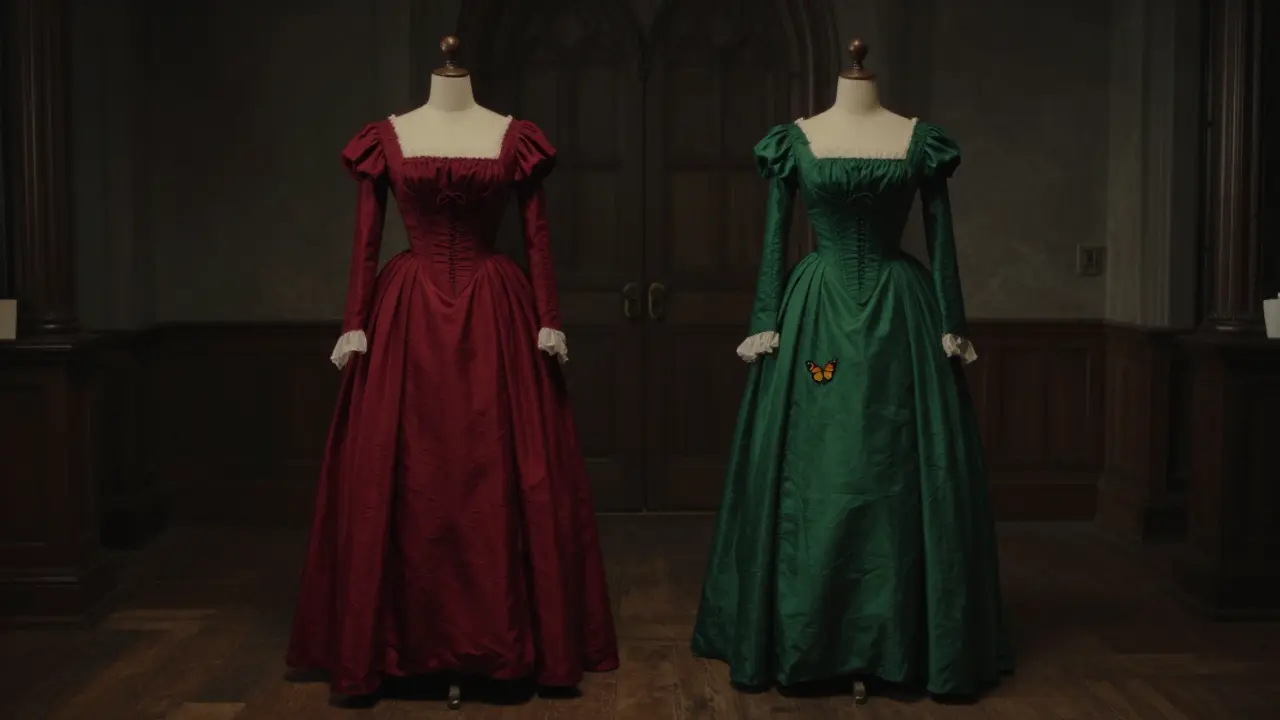
Costumes mark the division between the two roles at a glance. Claire wears deep reds. Elizabeth wears forest greens. Netflix Tudum identifies those palettes while discussing the work of costume designer Kate Hawley.
| Character | Costume palette stated in the sources | Story connection |
|---|---|---|
| Claire | Deep red | Victor’s late mother and childhood memory |
| Elizabeth | Forest green | William’s fiancée, and the character who shows the Creature kindness |
Hawley researched mid-19th-century clothing for the film, then worked within del Toro’s wish for a period world with imaginative freedom. For Elizabeth, Hawley drew from entomology, botany, insect anatomy, and organic cellular structures. She describes the colours and fabrics as having an iridescent, fleeting quality that echoes beetles and insects.
Elizabeth’s clothing also uses religious imagery. Hawley says the character’s bonnet functions like a halo, while coloured veils move the look away from a conventional version of that image. The design suits the way Victor and the Creature each place Elizabeth in a spiritual register, though their responses to her are very different.
The colours do more than keep Goth’s parts legible. They establish two visual identities. Claire’s red belongs to the mother Victor lost. Elizabeth’s green joins her to the natural world that fascinates her. Hawley’s documented inspirations support that reading; they do not confirm a hidden colour code beyond what the designers discuss.
What the film leaves open
The available interviews establish why Goth connects Elizabeth and Claire emotionally: maternal care, lost childhood comfort, and Elizabeth’s response to the Creature. They establish how costume design distinguishes the characters: deep red for Claire and forest green for Elizabeth.
They leave one key point unanswered. Del Toro’s precise reason for casting Goth in both parts remains unstated in these sources. Goth’s recollection of their early conversation is a thoughtful possibility, not confirmation.
That uncertainty gives the pairing room to work on screen. Viewers can track the clear facts of the story while deciding how much weight to give the resemblance between Victor’s mother and the woman who sees the Creature with compassion.
Did Elizabeth’s kindness change how you read Victor’s rejection of the Creature? Do Claire’s red costumes and Elizabeth’s green costumes make the double casting feel more connected, or more separate?
