Noah Kahan in Los Angeles: the Vermont songwriter who filled a stadium he once ran away from
A folk songwriter from a Vermont town of about a thousand people just headlined one of the largest stadiums in Southern California.
Why Noah Kahan and Los Angeles ended up in the same search box
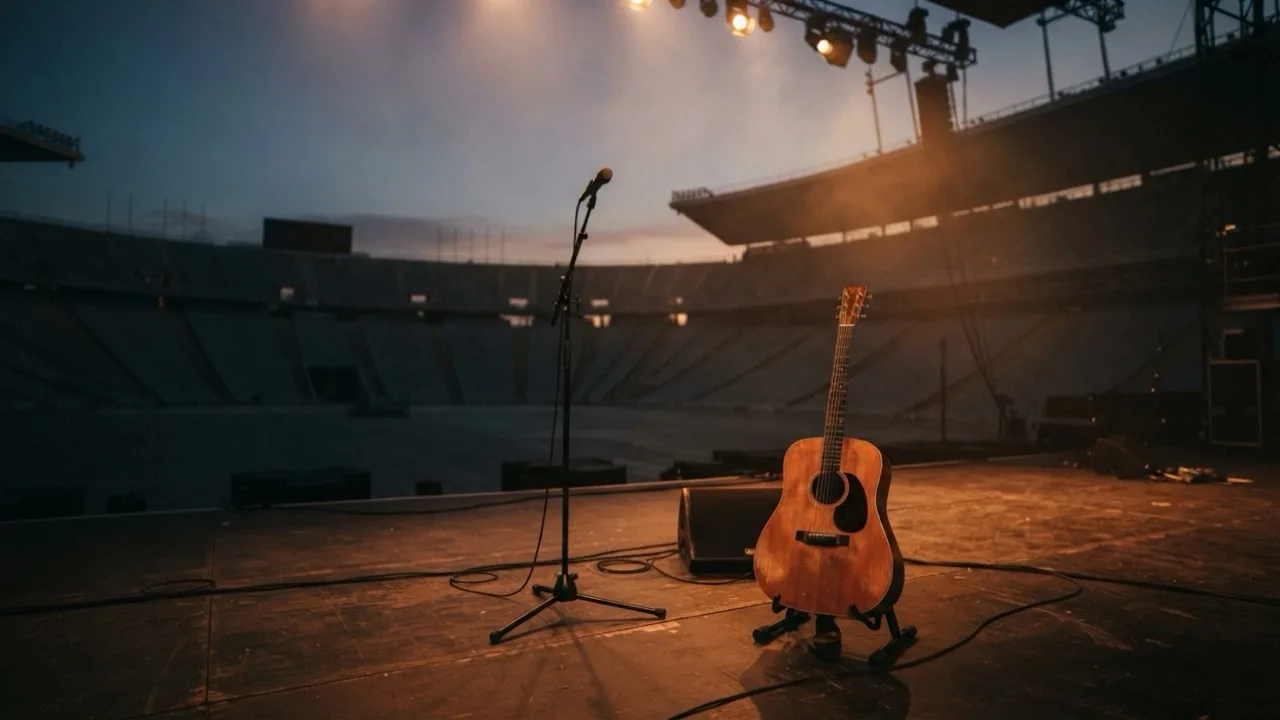
If you typed Noah Kahan Los Angeles into a search bar this week, you were almost certainly chasing one night. In the middle of August 2026, a singer from a Vermont town of roughly a thousand people headlined the Rose Bowl, the enormous open bowl of a stadium on the northern edge of the Los Angeles sprawl. His touring team billed it as the biggest headline show of his career, and nobody argued. A folk-leaning songwriter who built his name on long winters, small towns and the ache of staying put stood in the middle of a stadium that normally belongs to college football.
Here is the detail that trips up half the people searching, and that no automatic answer panel bothers to sort out. The Rose Bowl is not in Los Angeles. It sits in Pasadena, about ten miles north east of downtown LA, tucked into a leafy valley called the Arroyo Seco. Locals know the difference and will tell you so. Ticket sites, tour posters and search engines file the whole thing under Los Angeles anyway, which is precisely why so many people end up hunting for a city that was never printed on the ticket.
Where did Noah Kahan actually play in the LA area?
The Pasadena date was part of The Great Divide Tour, which opened in June 2026 and has been rolling across North America and Europe since. Getting to a stadium of that size took him the better part of a decade of clubs, then theatres, then the arena rooms, then the enormous shared bills that run through the big American festival circuit. The Rose Bowl was the top of that ladder rather than a lucky accident, and for a lot of West Coast fans it was the first chance to see the full production instead of a slot squeezed between two other acts.
Who is Noah Kahan, and how old is he?
Noah Kahan was born in 1997 and is now 29. He grew up in Strafford, Vermont, a hill town of dirt roads, sugar maples and the kind of small ponds you would take a little aluminium boat out on. He started posting songs as a teenager, was signed young, and spent his early twenties learning the difference between being a promising signing and actually having an audience.
His first album, Busyhead, arrived in 2019. A stripped-back EP called Cape Elizabeth followed in 2020, recorded at his childhood home when touring stopped. I Was / I Am came in 2021. Then, in 2022, Stick Season changed everything. The title refers to the grey New England stretch between the last leaves falling and the first proper snow that opens the ski season, a few weeks nobody writes songs about. He wrote most of it in a barn his father built. It turned him into an arena act, earned him a best new artist nomination at the Grammys, and gave listeners a vocabulary of very specific local detail, place names and family shorthand that works the same way regional sayings carry an entire place in a handful of words.
Day to day, the job is less romantic than the songs suggest: writing, demoing, rehearsing a two hour set, and a great deal of driving. Several of his best known tracks are built for exactly that, the sort of songs that live on the phone plugged into a car stereo through a dashboard adapter on a long drive home. It is no coincidence that the Rose Bowl set opened with a song called American Cars.
The Los Angeles chapter he already lived, and left
This is the part the quick news briefs skip, and it is the more interesting half of the Noah Kahan Los Angeles story. He has been to LA before, not as a visiting headliner but as a young artist trying to make a career work there. Busyhead was recorded in Los Angeles. He went back at the end of 2020 to work on the record that became I Was / I Am. When touring shut down, he retreated to Strafford instead, and the songs that eventually made him famous came out of that retreat rather than out of a rented room in California.
That tension, the city where the industry lives versus the town where the songs live, runs straight through his 2026 Netflix documentary, Noah Kahan: Out of Body. Directed by Nick Sweeney, it premiered at the South by Southwest festival in March 2026, won the audience award in the festival music strand, and landed on Netflix on 13 April 2026. It mixes concert footage from Fenway Park and Madison Square Garden with quiet scenes filmed alongside his family in Vermont, and it ends with him deciding to move back to Strafford for good. It is one of those documentaries people finish and immediately start searching about, in the same way they hunt down an explanation of how a Netflix drama actually ends.
So a stadium show on the edge of Los Angeles is not just a big date on a poster. It is a songwriter playing the largest room of his life in the exact city he decided was not for him, singing songs he wrote because he left. That is a better story than the two line brief most outlets ran, and it is the sort of corner we like to sit in at the fotobreak news desk.
What happened at the Rose Bowl
The set ran to roughly 27 songs, weighted towards The Great Divide and Stick Season, with older favourites folded in. Then came the moment that pushed the night into everyone's feeds: Chappell Roan walked out as a surprise guest and the two performed California, a song from her own debut album about the strange loneliness of moving to the West Coast. Sung in a stadium a few miles from Hollywood, by two artists who both came from somewhere much smaller, the choice landed hard enough that the clip travelled faster than any review.
That is the mechanics of the attention, and it is worth naming. One song, filmed on thousands of phones, cut into fifteen second pieces, spreads through the celebrity feeds and fan threads that live-post entertainment gossip in real time. Within hours, listeners were pulling the lyrics apart line by line, the same close reading fans give a rap verse that hides its references in plain sight. Something goes viral now roughly the way a food trend does: one shareable image, a thousand recreations, then a wave of people searching the name behind it.
The people around him
Family is not a footnote here, it is the source material. His parents and his home town appear throughout the documentary, and his father's barn is where the breakthrough record was written. On the production side, The Great Divide was made with Aaron Dessner, the guitarist of The National who has become one of the most in demand producers in American songwriting, and Gabe Simon, a long time collaborator who has worked on Kahan's records for years.
He also collaborates generously. Dial Drunk was reissued with Post Malone, Northern Attitude with Hozier, and that second one leans on the cold, plain-spoken northern imagery that turns up everywhere from folk songs to a crossword clue about the North Star. If you like what he does, the neighbouring shelf holds Chappell Roan, Zach Bryan, Hozier and the young jazz-pop songwriter Laufey, all artists whose listeners want the person as much as the record, in the way audiences now dig into the background of any stadium-filling musician they have just discovered. His own connection to Vermont has become part of the brand in the same affectionate way a comic actor's bond with his home state follows him through every interview.
He has also spoken publicly, for years, about his own mental health, and set up a fundraising project named after his first album that channels money from touring into mental health organisations. He talks about it plainly, on stage and off, and leaves it there.
What to listen to, where to follow him, and what happens next
The Great Divide came out on 24 April 2026 through Mercury Records. It runs to 17 tracks and a little over 77 minutes, and it went to number one in both the United States and the United Kingdom. The singles arrived in sequence across the year: the title track in January, Porch Light in March, Doors in May. Out of Body is streaming on Netflix. Everything else lives on the usual platforms and on his own social accounts, where the tone is far sillier than the songs.
The tour continues into further dates, so the practical advice is simple: put the on-sale on a calendar you actually look at, buy from the official seller, and check the city on the ticket rather than the city in the headline. Meanwhile the songs keep having a second life online, in acoustic covers, in bedroom versions built with software that strips the vocal out of a track, and in the first fumbling attempts of kids working out chords in a music tool that runs straight in a browser. For a songwriter who mostly wanted to go home to Vermont, that may be the most durable measure of the Los Angeles night: not the size of the stadium, but how far the songs travelled afterwards.
People also ask
Where did Noah Kahan play in Los Angeles?
He headlined the Rose Bowl in Pasadena in mid August 2026, as part of The Great Divide Tour. The venue is widely listed under Los Angeles, but it is actually in Pasadena, about ten miles north east of downtown LA.
Did Noah Kahan ever live in Los Angeles?
He spent time working in Los Angeles early in his career. His debut album Busyhead was recorded there, and he returned at the end of 2020 to work on I Was / I Am. He later went back to Strafford, Vermont, where he wrote most of Stick Season.
Who joined Noah Kahan on stage at the Rose Bowl?
Chappell Roan appeared as a surprise guest and the two performed California, a song from her debut album. The clip spread widely online in the hours after the show.
How old is Noah Kahan and where is he from?
He was born in 1997 and is 29. He is from Strafford, Vermont, a small hill town in the east of the state, and his New England roots run through almost all of his songwriting.
