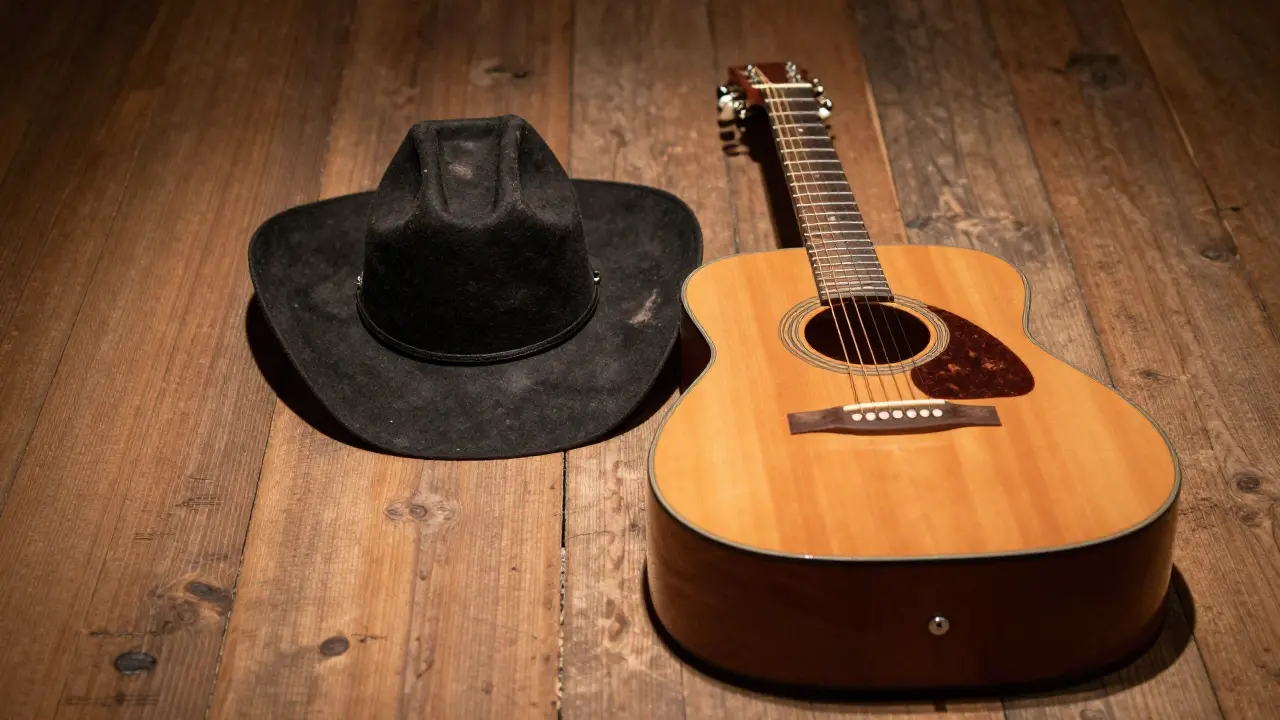
Pony arrived in 2019; Bronco followed as Orville Peck’s next full-length album. Across those releases, the visible markers stayed familiar: a fringed mask, cowboy hat, Western clothes, country music, and a performer who kept his face out of public view. The change documented in his interviews is less a replacement of that persona than an expansion around it. Bronco reached toward more sounds and a more personal period of writing, while the mask remained part of the public image.
Pony: country music through Peck’s early public image
In its 2019 profile, W Magazine described Pony through several musical references. The article heard Peck’s bass-baritone alongside Johnny Cash and Roy Orbison, with guitar parts moving between rockabilly, blues, and shoegaze distortion. That description matters because it places the album outside a narrow reading of country as one fixed sound. W presented the record as country-rooted music with styles from several directions audible in the arrangements.
The same profile connected that sound to a visual identity. Peck appeared publicly in leather-and-fringe masks that covered most of his face while leaving his eyes and jawline visible, according to W. He paired them with cowboy hats and old-school Western clothes, though the article also mentioned appearances with a vintage T-shirt and jeans. The cowboy image was therefore recognizable, but it did not function as a single costume formula.
The mask was already inseparable from Peck’s public presentation by the time Pony was being discussed. Yet the 2019 interview leaves its interpretation open. Peck said he liked to use the mask “as an art form.” When asked about possible references behind it, he declined to decide its meaning for listeners. His stated preference was for people to reach their own conclusions.
That point sets a firm limit on any comparison between the albums. The mask can be described as fringed, leather, handmade, and paired with Western clothing because W reported those details. It cannot be assigned a secret message, an exact cultural reference, or a psychological explanation from these interviews. Peck did not supply one in the material here.
A cowboy figure with room for interpretation
The cowboy was more than clothing in Peck’s account of Bronco. In his later interview with W Magazine, he said he had been drawn to country music and to the cowboy as an “esoteric figure” since childhood. He described seeing cowboy figures in westerns and television as outsiders whose loneliness and otherness could be treated as strengths.
That statement gives the cowboy imagery a documented emotional frame, but it still does not turn every feature of Peck’s image into a code. The 2022 interview records what he said drew him to the figure. It does not establish that every lyric, mask, video, or outfit has one intended reading.
Peck also spoke about the wider cowboy aesthetic in pop culture. He said that a burst of cowboy and Western imagery in fashion and art happened around the start of his project and worked in his favor. He later saw that imagery as more embedded in pop culture, pointing to the fact that a rapper in a cowboy hat no longer drew the same surprise. His comments describe a change in public fashion around the project, not a claim that he created that shift.
The mask remained part of that public image. W wrote in 2022 that Peck had never appeared publicly without a fringed mask. The continuity is plain: Pony introduced an artist whose face was concealed behind leather fringe and cowboy styling; Bronco kept the same recognizable public silhouette.
Why Bronco is a wider musical record in Peck’s own account
The title itself invited comparison. W called a bronco an “equine level-up” from a pony and described the album as an expansion of Peck’s interests. The magazine named bluegrass and psychedelic rock among the influences he had cited. Those references broaden the musical frame beyond the rockabilly, blues, and shoegaze elements heard in Pony by the 2019 profile.
Peck tied that renewed inspiration to music he had loved in high school. During the pandemic, he returned to Bakersfield country and Laurel Canyon folk. He told W that revisiting music from his younger years gave him a different perspective and started to inspire him again. The statement identifies influences that fed the period around Bronco. It does not prove a track-by-track formula or a full list of every record he heard while making it.
He also called Bronco “a sort of desperate catharsis.” In the same interview, he said he was going through a large personal shift, shaped by the interruption of work during Covid and by reconnecting with himself personally. That is Peck’s own description of the writing period. It gives the album a personal context without inviting strangers to fill in details he did not share.
The album’s visual world also opened outward in the material described by W. The article mentioned friends appearing in videos, including Norman Reedus and Margaret Cho. It identified Riley Keough as the performer in the video for “Hexie Mountains” and said she had earlier appeared on Peck’s cover of Lady Gaga’s “Born This Way.” These credits show that the Bronco era included collaborators and friends on screen. They do not by themselves explain the meaning of the videos.
| Element | Pony in the 2019 W profile | Bronco in the later W interview |
|---|---|---|
| Release place in the catalog | Debut album, released in 2019 | Sophomore full-length after Pony |
| Sound described or cited | Bass-baritone; rockabilly, blues, and shoegaze distortion | Bluegrass and psychedelic rock among cited influences; renewed interest in Bakersfield country and Laurel Canyon folk |
| Public image | Fringed leather masks, cowboy hats, Western clothing | Fringed mask still part of his public appearance; cowboy image remains central |
| Personal context | The profile focused on the debut’s sound and style | Peck called the writing a “desperate catharsis” during a personal shift |
What changed, and what stayed put
The strongest continuity between the two albums is visual. The mask and Western styling appeared in the 2019 account of Pony and remained present in the 2022 account of Bronco. Peck’s refusal to give a fixed explanation for the mask also matters across both periods. A listener can respond to the image, but the two interviews do not authorize a definitive reading of it.
The musical comparison is more textured. Pony was described through country, rockabilly, blues, and shoegaze. Bronco was presented as a larger field of interests, including bluegrass, psychedelic rock, Bakersfield country, and Laurel Canyon folk. The evidence supports a widening set of reference points. It does not establish that Bronco abandoned the earlier sound or that every song belongs neatly to one influence.
The titles create an obvious visual pair, and W made the horse comparison directly. Pony and Bronco can be read as linked names within the cowboy vocabulary that shaped Peck’s public work. The later article’s “level-up” wording is a journalistic observation from W, not a confirmed artistic thesis supplied by Peck.
His own comments do support a change in personal setting around the second album. The pandemic stopped his work, he said, and he was reconnecting with himself. He also returned to music he had loved when younger. Those details make Bronco sound rooted in reflection and renewed influence. They do not disclose the private events behind the record, and there is no need to invent them.
The limits of the comparison
Two interviews establish a useful outline. Pony arrived with a deep voice, hybrid guitar textures, and a masked cowboy image. Bronco kept that image while expanding the set of musical influences discussed around the record. Peck described the later writing as cathartic and personal, but he protected the boundaries of what he wished to explain.
The same interviews leave major questions open. They do not give the mask a final meaning. They do not explain every lyric or video. They do not prove why audiences responded to either album in a particular way. They also do not turn the cowboy figure into a single identity label. Peck’s comments point to his attraction to outsiders and antiheroes, while keeping the rest available for listeners to consider.
That restraint is part of the documented story. From Pony to Bronco, the fringed mask and cowboy imagery stayed in view. The music around them grew broader, and Peck spoke more directly about inspiration and catharsis. The private meanings behind the image remain where he left them: open.
What do the bluegrass, psychedelic rock, Bakersfield country, and Laurel Canyon folk references add to your hearing of Bronco? Which details from the two interviews feel documented, and which interpretations should remain your own?
