Salt Hank at the US Open: the $38 French Dip Everyone Queued For, and the Man Behind It
Henry Laporte, the sandwich video maker turned West Village restaurateur, became the most talked-about name in the US Open food village.
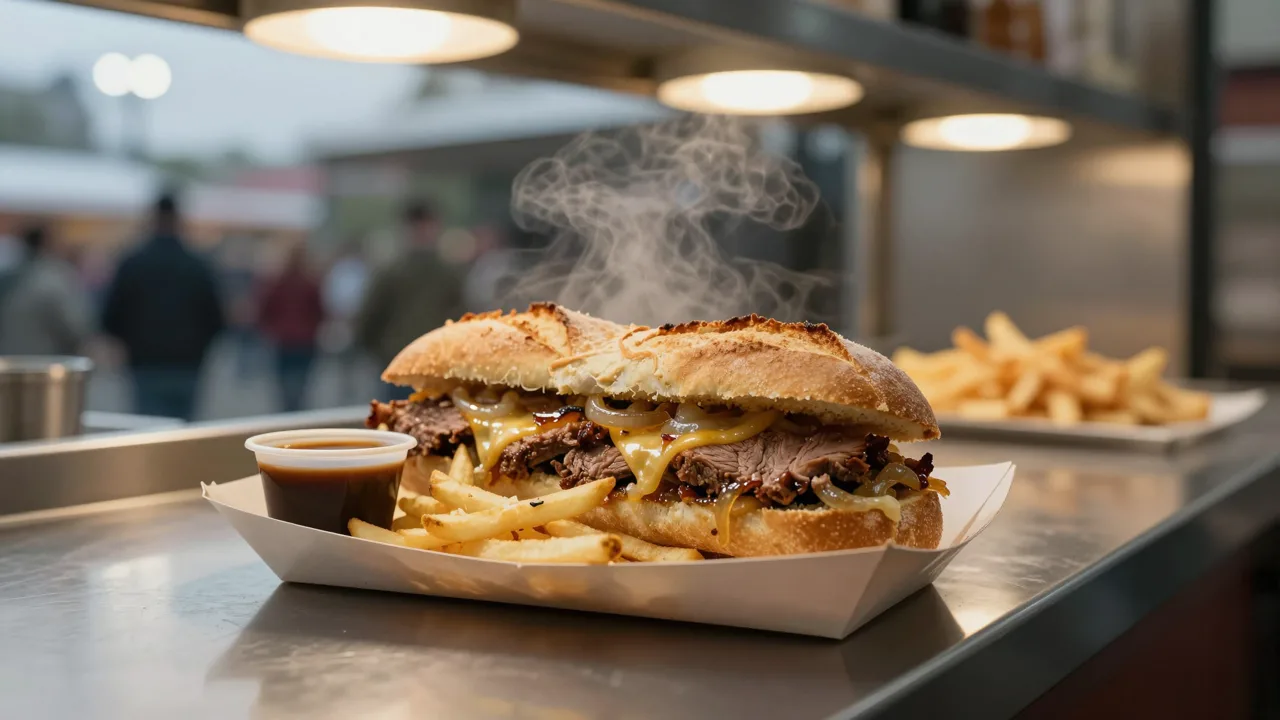
What is in the Salt Hank US Open sandwich, and what does it cost?
If you searched for the Salt Hank US Open sandwich, you probably want three plain facts before anything else, so here they are. The item is a French dip. It is built on prime rib supplied by the New York butcher Pat LaFrieda, layered with slow-cooked caramelized onions, melted provolone and a horseradish aioli, tucked into a baguette, and served with a cup of house-made jus for dipping. A pile of matchstick fries comes in the same box. At the USTA Billie Jean King National Tennis Center in Flushing Meadows, Queens, it sells for $38.
The stand is easy to find, which is part of why it took over the tournament's food conversation. Salt Hank's has a booth in the food village across from Arthur Ashe Stadium, close enough to the main gate that it is one of the first things ticket holders walk past on the way in. Reported waits during the tournament sat in the fifteen to twenty minute range, which at a Grand Slam counts as a compliment rather than a complaint. And the price, for all the noise around it, is not the outlier people assume: a hot pastrami sandwich on the same grounds runs about the same, a lobster roll is a dollar more, and a burrito is $24. The 2026 tournament runs from 23 August to 13 September, so as of today there is one more day of tennis, and one more day of sandwich.
One detail says everything about how seriously this was taken. The team closed the West Village restaurant for the run of the Open and moved staff and equipment out to Queens, so the booth would be worked by the same hands that work the shop. That is not a licensing deal with a logo on a canopy. That is a small restaurant emptying itself into a tennis tournament for three weeks. It is the kind of story that turns a viral dish into a proper national food trend with a queue attached, and the reason so many people are now searching for a name they had only half registered.
Who is Salt Hank? The real name behind the sandwich
Salt Hank is Henry Laporte, an American cook and video maker in his early thirties, born and raised in Petaluma, California. He studied broadcast journalism at the University of Colorado Boulder, which turns out to be the most useful detail in his whole biography. He did not come up through restaurant kitchens and a stack of stages at fine-dining rooms. He came up understanding how a camera holds attention, and then pointed it at food.
His early working life was the unglamorous version: production assistant jobs, including time at the food media company Tastemade, the sort of role where you carry things and watch closely. Then he started making his own short cooking videos, mostly sandwiches, mostly loud and unapologetically rich. Crisp edges, dripping sauces, hands tearing bread. He built an audience of around 2.5 million on TikTok and roughly 2 million on Instagram, close to 5 million followers across platforms, which puts him in the same working bracket as the food reviewers whose verdicts can fill a restaurant overnight.
What does Salt Hank actually do day to day?
Three jobs, braided together. He still makes short videos, the ones that made his name. He also runs a longer-form YouTube show called Side of Salt, with somewhere north of 80,000 subscribers, in which he pulls apart and rebuilds fast-food classics: the Taco Bell Cheesy Gordita Crunch, the In-N-Out Double Double with animal fries. It is patient, nerdy work, closer to a workshop than a highlight reel, and it separates him from creators who only ever post the ten-second money shot. If you follow creators who moved from short clips into full-length episodes, the pattern will be familiar.
Then there is the cookbook. Salt Hank: A Five Napkin Situation came out in 2024, became a New York Times bestseller, landed on Esquire's list of the best cookbooks of that year, and carried a cover blurb from Gordon Ramsay. The title is the whole thesis. Nothing in it is designed to be eaten tidily.
And then, in 2025, the restaurant. Salt Hank's opened on Bleecker Street in Manhattan's West Village with one entree on the menu: the French dip. Sandwich, sides, done. Reported prices at the flagship are around $34 for the sandwich with shoestring fries a few dollars more. The single-item menu was a risk that became the brand, and the line down Bleecker became the proof. He has since picked up the sort of industry nods that follow that kind of momentum, including a spot on Food Network's 2026 Hot List and a TikTok Creator to Watch selection, plus mainstream appearances such as a 2025 turn on The Drew Barrymore Show and a Spotify Wrapped promotion. This is exactly the kind of name fotobreak exists to explain properly, because most outlets gave it two lines and moved on to the tennis scores.
Why is Salt Hank trending right now?
Two things landed within weeks of each other, and together they created the search spike.
The first is the US Open debut itself. A tennis major is one of the few American events where the food gets covered as hard as the sport, and the 2026 edition arrived with a genuinely stacked culinary lineup. The last tournament's breakout was a plate of fried chicken nuggets served with caviar. This year the buzz shifted to a $38 sandwich, and the shift is the story: attention at these events now flows toward whoever already has an audience arriving with their phones out, the same dynamic that governs festival-scale crowds that show up for the lineup and post the queue.
The second is a business announcement dated 20 August 2026. Wonder, the food delivery and food hall company, acquired Salt Hank's. Terms were not disclosed. Chef Daniel Rubenfeld joined Wonder to oversee the culinary direction of the brand, Henry Laporte stayed on as a partner guiding its growth, and co-founder Ian Henderson-Charnow remained involved as an adviser. The Bleecker Street shop keeps operating, and the French dip is set to appear at Wonder's Upper East Side location from autumn 2026.
Put those side by side and you can see why the internet had opinions. A cult one-sandwich shop sells to a larger company, then immediately serves tens of thousands of strangers at a stadium. Some commenters online worried out loud that scale would flatten the thing they loved. Laporte's public answer was straightforwardly practical rather than defensive: the ingredients are sourced the same way, and the tournament sandwich is meant to be the restaurant sandwich. Anyone who has watched a small brand try to grow without losing its edge will recognise the tension, the same one that shows up whenever a founder starts talking publicly about scaling.
The people around him
The family detail is the one most readers miss. Henry is the son of Leo Laporte, the veteran technology broadcaster, so he grew up around microphones, live shows and an audience that expects you to be interesting on schedule. He is not the first person to turn a childhood spent near a camera into a career of his own, a path shared by people who grew up with a well-known parent and built something separate. Father and son have since sat down together on Leo's own show to talk about family, fame and French dips, which is about as warm a version of that story as you could ask for.
Professionally, the two names to know are Rubenfeld, the chef who protects the recipe, and Henderson-Charnow, the co-founder on the business side. The Bleecker Street team is small, which is why closing the shop to staff the Open made sense at all.
Then there are the neighbours in the food village, and they are worth knowing if you like this corner of the food world. Enrique Olvera brought Cosme, with duck carnitas. Eyal Shani brought the Mediterranean street food of Miznon, pita stuffed with rib-eye roast beef or chicken schnitzel. Simon Kim returned for a third year with the COQODAQ fried chicken concepts. Alex Guarnaschelli was back for a sixth year, Masaharu Morimoto set up a handroll and nigiri counter at the Arthur Ashe club level, and David Burke and Ed Brown handled other corners of the grounds. The Honey Deuce, the tournament's signature cocktail, returned as ever. It is a lineup that rewards anyone who follows New York chefs who get written up for a single signature dish or keeps an eye on regional chefs with fiercely loyal local followings.
Queens in early September also means the sandwich queue sat inside the busiest fortnight of the New York sports calendar, competing for attention with the Yankees catcher having a season worth watching and the young Mets arm fans keep asking about. Sport, food and phones, all in the same three blocks.
Where can you follow Salt Hank, and what happens next?
He posts as salt_hank on both TikTok and Instagram, which is where the short videos live and where announcements tend to appear first. The long-form Side of Salt episodes are on YouTube. The cookbook is in general trade circulation, and the restaurant has its own site with hours and the single-item menu. That is the whole footprint, and it is deliberately small: no sprawling merchandise line, no dozen ventures, one sandwich done repeatedly.
On money, the honest answer is that the public figures are the menu prices and nothing more. The Wonder deal's terms were not disclosed, and any number you see quoted as his net worth is an estimate rather than a disclosure. It is worth remembering that with creators generally, because the visible part of the business, the brand partnerships and endorsements that follow an audience, is rarely the whole picture.
What happens next is fairly clear. The West Village shop reopens its normal service now the tournament is finishing. The French dip starts appearing at Wonder's Upper East Side location this autumn, with more Wonder sites flagged over time, plus app pickup and delivery. A new season of the YouTube show has been signalled. And the open question, the one worth watching, is whether a sandwich that earned its reputation one queue at a time survives being available everywhere. That is a harder trick than going viral, and it is the same problem faced by home cooks whose kitchens became a look people copy, by television hosts who turned a kitchen into a brand, by a waterfront grill that suddenly gets discovered, and by short-video creators trying to build something durable off a feed.
If the answer turns out to be yes, a broadcast journalism graduate from Petaluma will have built one of the more unusual American food businesses of the decade out of exactly one sandwich. Either way, the people who stood in line at Flushing Meadows this fortnight got the original version, made by the original crew, and that is a decent thing to have eaten. For more on the names people are suddenly searching, our rolling coverage of the week's trending figures follows them as they arrive, and if you like watching audiences follow a creator out of the screen and into a real room, the story of streamers whose communities turn up in person is the same phenomenon with a different menu.
People also ask
What is in the Salt Hank sandwich at the US Open?
It is a French dip: prime rib supplied by New York butcher Pat LaFrieda, caramelized onions, melted provolone and horseradish aioli on a baguette, served with a cup of house-made jus for dipping and matchstick fries in the box.
How much does the Salt Hank US Open sandwich cost?
It sells for $38 at the tournament, fries and jus included. For comparison, the reported price at the West Village restaurant is around $34 for the sandwich, with shoestring fries charged separately.
Where is the Salt Hank's stand at the US Open?
In the food village across from Arthur Ashe Stadium at the USTA Billie Jean King National Tennis Center in Flushing Meadows, Queens, close to the main gate. Reported waits ran roughly fifteen to twenty minutes.
What is Salt Hank's real name, and where is he from?
His real name is Henry Laporte. He was born and raised in Petaluma, California, studied broadcast journalism at the University of Colorado Boulder, and is the son of technology broadcaster Leo Laporte. He now works in New York.
