Luke Combs Concert: What the Night Actually Looks Like, and the North Carolina Story Behind It
The Asheville-raised country singer built the least flashy stadium show in America, and it works because the crowd does half the singing.
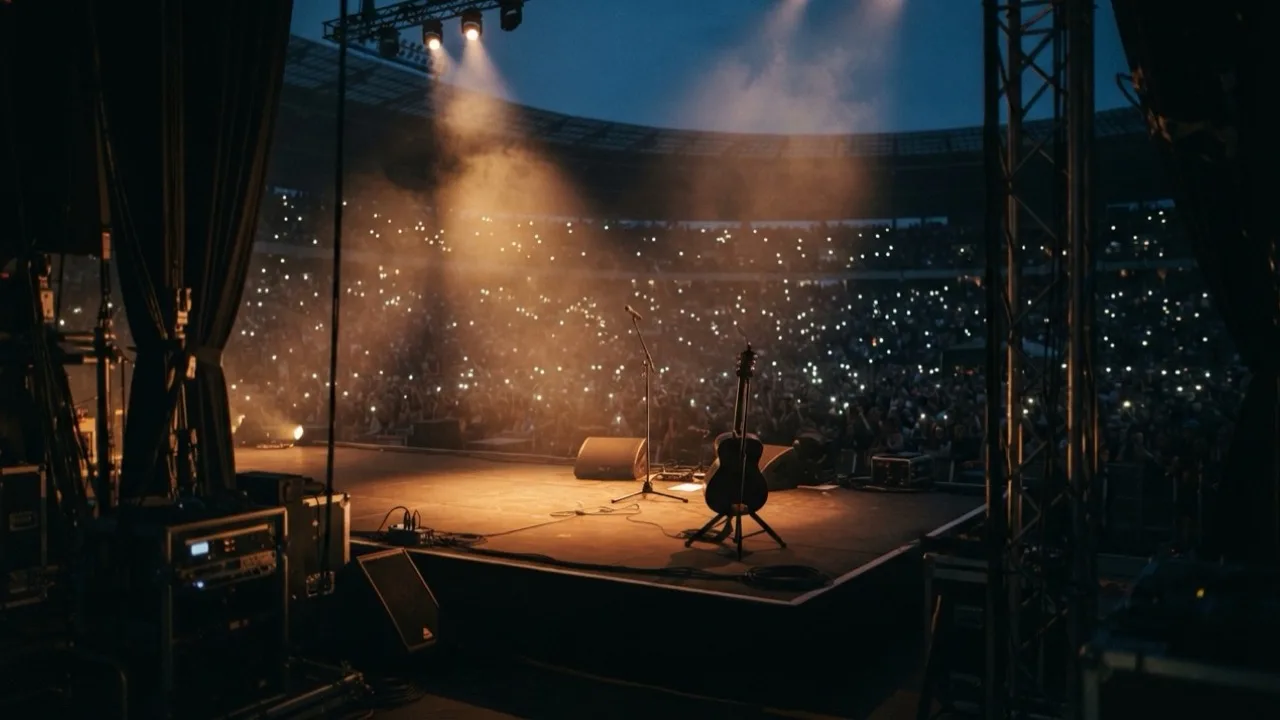
What a Luke Combs concert is actually like
Most people who type Luke Combs concert into a search bar are not looking for a biography. They want to know what the night is. How long does he play. Who goes on first. Are the seats behind the stage a mistake. Which songs is the whole building going to sing whether you know them or not. So that is where this starts.
A Luke Combs show is deliberately plain, and the plainness is the entire design. There are no dancers, no costume changes, no ribbons of fire. He walks out in jeans, a t-shirt and a ball cap, stands near a microphone stand and sings. The production money goes into video screens and sound rather than choreography, which is close to the opposite of the light-and-laser spectacle built around the kind of arena show a touring club DJ constructs around a single drop. At a Combs concert, the spectacle is the crowd.
How long is a Luke Combs concert and when does he go on?
Doors usually open a couple of hours before music starts, and a Combs bill normally carries two support acts, which means the headliner often does not appear until the evening is well underway. Exact times are set venue by venue and printed on your ticket, so treat that as the only authority rather than anything you read online. Past tours have handed those opening slots to artists like Cody Johnson, Jordan Davis, Riley Green, Lainey Wilson and Charles Wesley Godwin, several of whom went on to headline rooms of their own. Turning up late to this particular concert is a genuine waste of money.
The headline set typically runs somewhere between an hour and a half and two hours, and the song list is stable enough that you can revise. Expect Hurricane, When It Rains It Pours, Beautiful Crazy, Beer Never Broke My Heart, Forever After All, Doin This and his cover of Tracy Chapman’s Fast Car. On the biggest ones the audience gets loud enough that his own voice half disappears, which is a bit like what happens when people at home run a track through software that strips the lead vocal out to leave a karaoke backing. Fifty thousand people do it for nothing.
The rest is logistics. Stadium food has quietly turned into its own attraction, and the snack queues now behave the way a viral fried-chicken trend spreads from one venue to the next. Merchandise stands open early and empty fast, though the goods themselves are unglamorous: t-shirts, caps, a hoodie, closer in spirit to the basics rack of a global clothing chain than to a fashion drop. And the atmosphere sits somewhere between a football tailgate and the sprawling, all-day festival crowds that fill city parks each summer, only with more denim.
Who is Luke Combs, and where is he from?
His full name is Luke Albert Combs. He was born on 2 March 1990 in Huntersville, North Carolina, and grew up in Asheville, in the western mountains of the state. That makes him 36. North Carolina is not decoration in his story, it is the whole frame, in the way a performer’s home state can quietly explain everything about how they talk and what they sing about.
He went to Appalachian State University in Boone, a small mountain college town where the winters are real and the slopes are busy, the sort of place that runs on the same seasonal rhythm as a ski resort counting down to opening weekend. He studied criminal justice and left before finishing his degree to chase music full time. The detail people tend to miss is that he sang in the university chamber choir, which is where the ear came from. Blend, breath control and pitch under pressure are learned skills, the kind of thing children now poke at through free online tools that let you build harmony by dragging blocks around a screen, and he learned them properly before he ever wrote a hit.
How he got from a college choir to stadium stages
The climb was unfashionably slow. He played bars and small clubs, worked ordinary jobs, and put out his own EPs before any label was interested. The self-released single Hurricane did the impossible in 2015 by charting without industry backing, and Nashville came to him rather than the other way around. His debut album This One’s for You arrived in 2017 and produced an unusually long run of number one country singles for a new artist. What You See Is What You Get, Growin’ Up, Gettin’ Old and Fathers & Sons followed.
What he actually does day to day, when he is not on a bus, is write. He writes in rooms with the same handful of collaborators, plain declarative songs about work, weather, marriage and small towns, which places him in a very old lineage of American folk songwriting built on ordinary language rather than clever wordplay. That plainness is why his lyrics rarely generate the line-by-line puzzle-solving you see when fans sit down to pull apart a rap verse for hidden references. There is nothing hidden. That is the trick.
He has been named country music’s entertainer of the year multiple times, and his cover of Fast Car in 2023 became one of the strangest crossover moments in years, ending with Tracy Chapman herself joining him on a Grammys stage. He now occupies the small club of artists who can put a football stadium on sale and expect it to go, alongside acts like the Puerto Rican superstar whose stadium residencies became global news and, on a slightly smaller scale, the New England songwriter who turned homesickness into sold-out arena nights.
Why Luke Combs concerts are trending right now
The mechanics of the attention are simple, and worth understanding because they repeat every year. Late summer is peak stadium season, so the searches spike when the tour is physically in front of people. Then the clips arrive: a phone video of forty thousand people singing a chorus, filmed from row 300, travels further than any press release. Every night produces a new one. Something we notice at fotobreak is that the search never says his name plus a song title, it says his name plus the word concert, because what people are chasing is the room, not the record.
There is also the goodwill. After Hurricane Helene tore through western North Carolina in 2024, Combs co-headlined a benefit concert in Charlotte with fellow North Carolinian Eric Church, staged in the same sort of venue that normally belongs to an NFL defensive back on a Sunday afternoon. It was his home region. People remembered.
Who is in his family and his band?
He married Nicole Hocking in August 2020, and they have two young sons, Tex and Beau. The 2024 album Fathers & Sons came directly out of that, a quieter record that lands somewhere near the emotional register of the notes people write for a newborn they have only just met. Curiosity about a musician’s private half is normal, and it drives the same search behaviour that sends listeners hunting for the partner behind a young jazz-pop singer. In his case he has answered it himself, in songs, which is the least dramatic way possible.
Professionally, the people around him have stayed remarkably fixed. His band and his co-writers overlap heavily, and several musicians who play in his live show also have credits on his records and have opened concerts for him. That continuity is audible: a Combs show sounds like a group of people who have played the songs several hundred times together.
Tickets, merch and what happens next
Tickets go through official sellers first, with an early window for members of his long-running Bootleggers fan club. Everything after that moves into resale, a market that behaves much like the sneaker platforms where scarcity sets the price rather than the seller, so prices swing wildly by city and date. Buy from the venue’s named partner if you can. Dates, cities and support acts are published on his official site and social accounts, and if you want the drive there to feel like part of the show, this is one of the few artists whose catalogue genuinely rewards a car stereo set up to stream properly from your phone.
His touring runs are regularly reported among the biggest-grossing in country music, though the precise figures shift year to year and come from trade publications rather than from him. What comes next is what has come before: more writing, more records, more nights where the loudest instrument in the building is several thousand strangers. For more on the people currently pulling those crowds, our rolling coverage of the names the internet is talking about keeps track.
People also ask
How long does a Luke Combs concert last?
His headline set generally runs between roughly an hour and a half and two hours, on top of two opening acts. Because start times are set by each venue, the times printed on your ticket are the ones to trust.
What songs does Luke Combs usually play live?
A typical night includes Hurricane, When It Rains It Pours, Beautiful Crazy, Beer Never Broke My Heart, Forever After All, Doin This and his cover of Tracy Chapman's Fast Car, with newer album tracks rotated in.
Where is Luke Combs from?
He was born in Huntersville, North Carolina in March 1990 and grew up in Asheville, in the western mountains of the state. He later studied at Appalachian State University in Boone.
Is Luke Combs married and does he have children?
Yes. He married Nicole Hocking in August 2020 and they have two young sons, Tex and Beau. His 2024 album Fathers and Sons was written around that part of his life.
